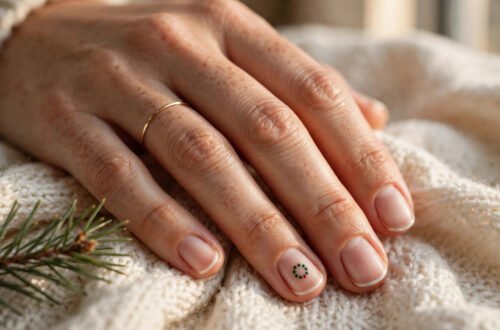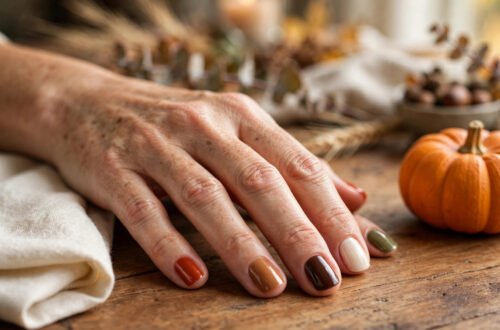







Christmas nails in 2026 are decided more by finish than by motif. The sets that stand out this season use a diffused velvet or cat-eye glow, a multichrome colour that shifts as your hand moves, a metallic red, or a quiet milky French with a single small accent. A gel set booked in the week before Christmas Day, Friday 25 December 2026, should still look fresh on New Year’s Eve, Thursday 31 December, with careful prep and aftercare. Keep most art to one or two accent nails, and let the finish do the work.
TL;DR: quick picks
- Easiest festive set: red velvet cat-eye on every nail, no art at all.
- Most 2026: multichrome over a dark base, or metallic red with chrome or gold-foil tips.
- Most wearable for work and family days: milky French with a thin line and one tiny red bow.
- Best for short nails: micro French, velvet depth, or one accent nail. Avoid busy art on every nail.
- Skip heavy three-dimensional art if you want zero maintenance for three weeks. A plain finish will age better than raised decoration.
How this guide is different
Glowberry Style already has two focused Christmas nail guides, and this one is not a repeat of either. The minimal guide rescales twelve tiny designs for very short nails, with a size rule for each one. The work guide chooses ten short designs that pass an office dress code. This pillar answers a different question: which finish should you choose, which design suits your shape and your calendar, and how do you make the set survive from Christmas to New Year’s Eve? If your nails are very short, start with the minimal guide and come back here for finish choices. If you need an office-safe set, the work guide is the stricter filter. Use this guide when you want the full seasonal range, including party finishes.
What is trending for Christmas nails 2026
The clearest change this year is that finish leads and motif follows. Several 2026 round-ups now put multichrome and duochrome first, alongside minimalist milky French with a single bow, while velvet and cat-eye are treated as the established classic rather than the new arrival. That does not make velvet dated. It means velvet is the safe, proven choice, and multichrome is the one that reads most current in photographs and under party lights.
Red is still the anchor colour, but it is deeper and more dimensional than a flat bright red. Think burgundy, oxblood, and deep cherry, with light moving through the polish. Green has moved from a single Christmas green to a family: emerald, forest, and deep sage, often with gold. White has softened into milky, frosted, and pearl versions that look like snow in daylight and glow under indoor light. Metallics are used in smaller doses than in past years. A chrome tip, a gold line, or one foil accent reads more polished than a full glitter set, and it chips less visibly at the free edge.
What has faded is the busy set where every nail carries a different picture. A snowman on one nail, a reindeer on the next, and stripes everywhere can look fun for a single evening, but it is hard to wear for a week, harder to keep tidy, and it dates quickly in photographs. The 2026 sets that age best use one colour family, one finish, and at most one repeated accent.
Velvet vs cat eye vs multichrome: choose your finish first
Velvet, cat-eye, multichrome, chrome, and pearl all use light, but they use it differently, and choosing the finish first makes every later decision easier. Velvet and cat-eye both use magnetic gel polish. The polish holds fine metallic particles, and a magnet moves them while the polish is still wet. Curing under a lamp then locks the pattern in place. The difference is what the magnet does.
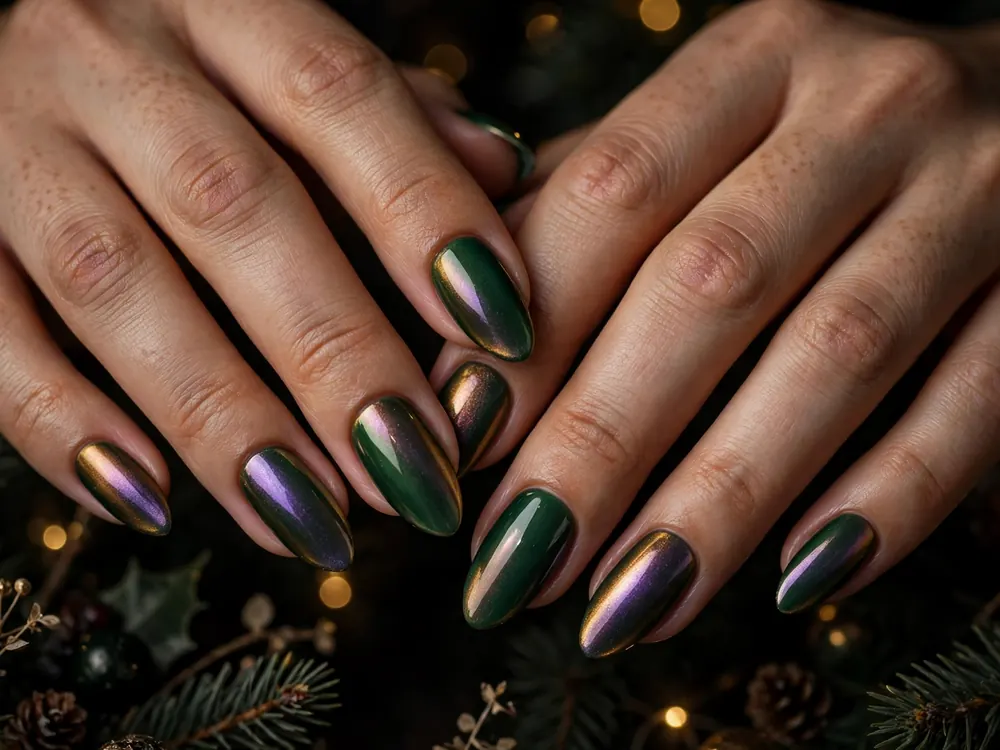
For velvet, the magnet is moved around the nail so the shimmer spreads across the whole surface. The result is a soft, diffused glow that looks like crushed velvet fabric as your hand turns. There is no single sharp line. For cat-eye, the magnet is held in one place so the particles gather into a defined band of light, like the slit in a cat’s eye or the line in a gemstone. The surrounding colour stays deeper, so the contrast is stronger and more dramatic. A third, newer variation uses a sheer base under the magnetic effect. The line sits inside the colour instead of on top of it, which softens the edge and adds depth. That sheer version suits short and natural nails especially well, because the effect does not need length to show.
Multichrome is different again. It is not a magnetic line. It is a pigment or powder that shifts colour with the viewing angle, for example from deep green to purple, or from burgundy to bronze-red. The base colour underneath controls the shift. Over black, the shift is vivid and dramatic. Over burgundy, it moves toward green and gold. Over a sheer pink base, the same pigment reads soft and rosy. If you want multichrome, ask about the base, not just the top colour, because the base is half the result. Chrome is the mirror finish, usually a powder rubbed over a cured gel base and sealed in. It is at its best on tips and accents. Pearl, sometimes called glazed, is the quietest of the group: a soft, pearly sheen that catches light without sparkling.
| Finish | What it looks like | Best for |
|---|---|---|
| Velvet (diffused magnetic) | Soft shimmer spread over the whole nail; light moves as the hand turns | Red and deep green, party sets, short nails |
| Cat eye (defined line) | A sharp band of light, with deeper colour around it | Statement sets, French-tip bands, longer nails |
| Multichrome / duochrome | Colour shifts under light, for example green to purple | 2026 statement sets, dark bases |
| Chrome / metallic | Mirror shine, gold foil, or chrome tips | Red metallic sets, French tips, one accent |
| Pearl / glazed | Soft pearly sheen, quieter than chrome | Milky French, daytime and office sets |
A useful salon rule: do not rely on the name alone. Names vary between salons and brands, and “velvet” is also used for a fuzzy flocking powder that is not magnetic at all. Show a photograph in the light you will actually be in, and describe the effect you want: “a soft glow all over, no sharp line” for velvet, or “one clear line of light” for cat-eye. If a salon does not stock magnetic gels in your colour family, ask before you book. Not every salon carries a wide magnetic range.
The 12 designs
The designs below are grouped by colour family. Each one names the finish, the shape it suits, and the exact wording to use at a salon, so you do not have to translate a photograph on the spot.
Reds
1. Red velvet cat-eye, every nail. This is the simplest set in the guide and, for many people, the best. A deep red magnetic gel is worked into a diffused velvet glow on every nail, with a glossy top coat and no art. It suits almond, soft square, and short nails, because the glow does not need length or decoration to register. It photographs well in warm indoor light and reads festive without a single motif. Ask for: “Deep red velvet cat-eye, soft glow all over, no sharp line, glossy finish.” Skip this if you want a high-contrast, dramatic line; ask for a defined cat-eye instead.
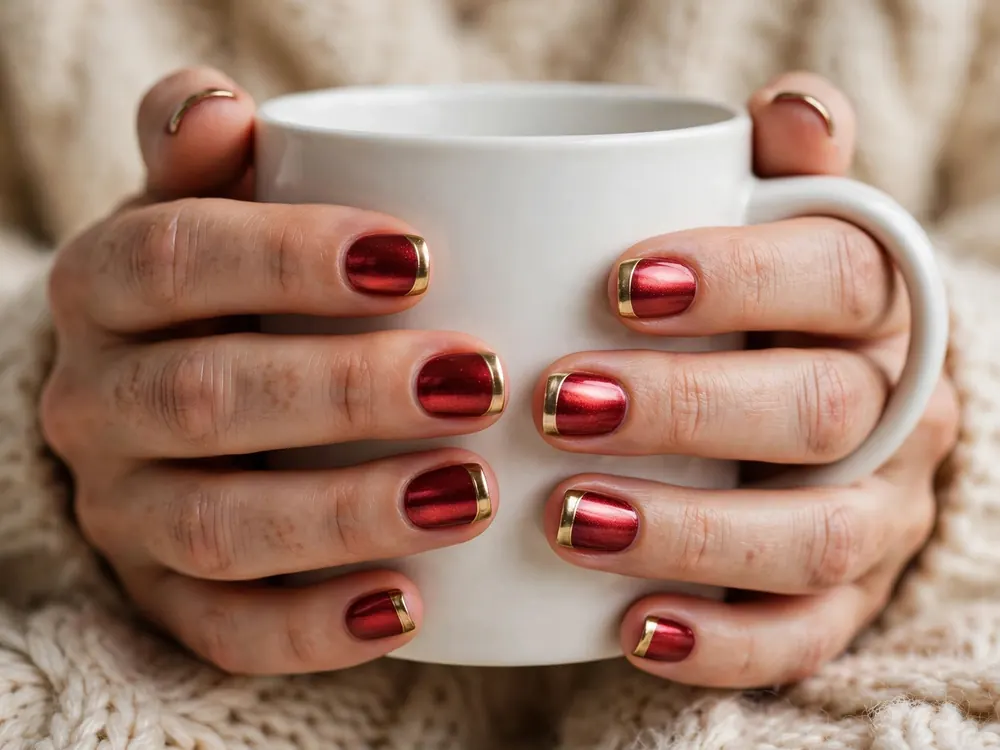
2. Metallic red with gold chrome tips. A metallic red base is paired with reflective gold chrome tips, kept narrow so the set stays elegant rather than loud. This suits almond and soft square nails best, where the tip has room to show as a clean band. The chrome tip is also practical: the free edge, which takes the most contact with keys and packaging, gets the hardest-wearing finish. Ask for: “Metallic red base, gold chrome French tips, milky or nude base only if you want the tip to read lighter.” At home, metallic gold polish is the closest approximation, but it will not give the same mirror effect.
3. Burgundy velvet with one gold snowflake. A deep burgundy velvet set carries the whole manicure, and exactly two nails, usually the ring fingers, carry one fine gold snowflake each, painted with a liner or placed as a decal and sealed under top coat. Keeping the snowflakes to two nails is the point. The velvet does the festive work, and the snowflake is a detail, not a theme. This suits medium almond nails and formal dinners. On very short nails, use one snowflake on one nail, or skip the snowflake and let the burgundy stand alone. Ask for: “Burgundy velvet cat-eye, one gold snowflake on two nails only.”
Greens
4. Emerald velvet cat-eye. Emerald is the green that carries velvet best, because the depth of the colour gives the shimmer somewhere to sit. The set is a single emerald magnetic gel, diffused across every nail, with no art. It suits medium and long almond nails, and it pairs naturally with gold jewellery and dark winter knits. On short nails it still works, but keep the nails neatly shaped and the cuticles tidy, because a dark, glossy set shows an uneven edge more readily than a pale one. Ask for: “Emerald velvet cat-eye, all nails, glossy top coat.”
5. Forest green multichrome. This is the most 2026 design in the green family. A forest green base carries a multichrome shift, often toward purple or gold depending on the pigment and the light. In daylight it reads as a deep, polished green. Under party lights it shifts and becomes the talking point of the set. It suits almond and oval shapes, where the curve of the nail gives the shift room to move. Ask for the base by name: “Forest green base with multichrome shift, show me the shift in daylight and under warm light before you cure.” Do not choose this from a bottle alone. The shift is the design, and it must be seen on a nail, not in a photograph of a bottle.
6. Deep green with a gold foil tip. A deep green cream polish is finished with a thin gold foil or chrome line along the tip, rather than a full French band. The line should be fine, about the width of a thread, so it reads like jewellery. This suits short square and squoval nails, where a straight, clean tip line is easiest to keep tidy. It is also one of the easier green designs to maintain, because tip wear shows as a softening of the line rather than a chip in a pattern. Ask for: “Deep green, thin gold foil tip line, glossy finish.” Keep foil sparse. Heavy foil tips the set from polished to party-only.
Whites, frosted, and pearl
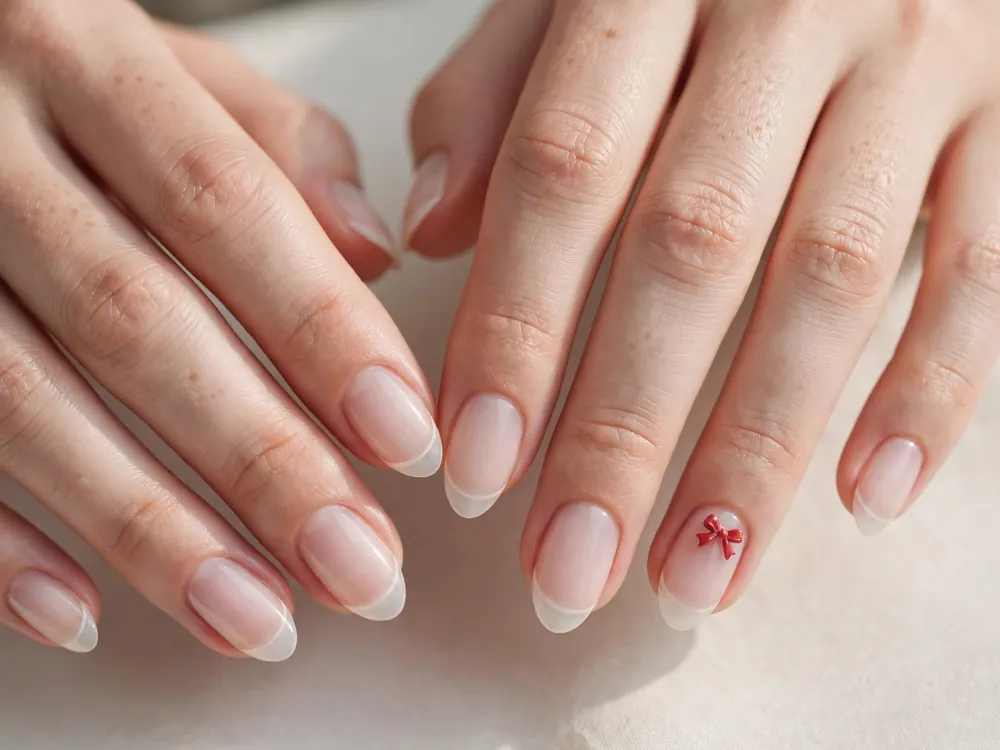
7. Milky French with one red bow. A milky, translucent base is finished with a thin white French tip, and one nail carries a single tiny red bow, painted or placed as a small decal. This is the minimalist design that leads many 2026 round-ups, and it earns its place because it is wearable everywhere: work, family lunch, and a party in the same week. It suits short, almond, and soft square nails, and it is the safest choice if you are unsure about a bolder finish. The bow must be small. A large bow crowds a short nail and lifts at the edge. Ask for: “Milky French, thin tip, one small red bow on the ring finger only.”
8. Frosted white with a silver chrome tip. A frosted white base, with a fine silver chrome tip, looks like snow at the edge of the nail. The chrome should be narrow and clean, not a thick silver band, so the set stays soft. This suits short round and squoval nails, where the tip line follows the natural shape of the nail. It is a good choice for pale skin and for anyone who finds a full white set too stark. Ask for: “Frosted white base, narrow silver chrome tips.” Note that pale shades stain more easily, so wear gloves for cooking with turmeric, berries, or red wine sauces, and keep a top coat for mid-week touch-ups.
9. Champagne pearl on a sheer base. A sheer nude base is washed with a fine champagne-gold pearl shimmer, spread evenly so the nail glows instead of glittering. From a few feet away the nails simply look polished and healthy. Up close, the warmth shows. This suits every shape, including very short nails, and it is the most forgiving sparkle format in the guide: small imperfections disappear into the texture, and tip wear is hard to spot. Ask for: “Sheer nude base with champagne pearl shimmer, no glitter, glossy finish.” This is also a realistic at-home design with a single shimmer polish or a shimmer top coat over your usual nude.
Metallics, French, and minimalist
10. Multichrome black. Black polish with a multichrome finish shifts between blue, purple, red, or silver depending on the light, instead of sitting flat. It is dramatic without being a costume, and it works with minimalist outfits, silver jewellery, and evening wear. It suits almond and soft square nails, where the shift has a smooth surface to travel across. If you want a subtler version, choose a black polish with fine shimmer rather than a highly reflective multichrome formula. Ask for: “Multichrome black, show me the shift under warm light.” A glossy top coat emphasises the shift; a matte top coat will mute it, so do not mix the two unless that is the effect you want.
11. Gold chrome French on a milky base. A milky, translucent nude base is finished with French tips in reflective gold chrome. The structure is still a French manicure, neat and familiar, but the gold makes it festive and coordinated with most jewellery. This suits short almond nails best. Chrome is a salon service: the mirror effect comes from powder rubbed over a cured gel base and sealed in. At home, metallic gold polish is the closest match, but it will read as metallic paint rather than a mirror. Ask for: “Milky nude base, gold chrome French tips, gel base if you type all day.”
12. Plum cat-eye with a bronze line. A deep plum magnetic gel carries a defined cat-eye line with a bronze shimmer, so the band of light reads warm rather than silver. This is the design to choose if red and green both feel expected and you want something moodier. It suits medium almond and oval nails, and it pairs well with plum, charcoal, and cream clothing. Ask for: “Deep plum cat-eye, defined line, bronze shimmer.” If the line is too sharp for your taste, ask for it to be softened toward velvet before curing. Once cured, the line cannot be softened without starting again.
Short Christmas nails: what works, what crowds the nail
Short nails suit Christmas better than most people expect, provided the design respects the size of the nail bed. The rule that runs through this whole guide, and through the minimal guide for very short nails, is scale. One detail per set, not one detail per nail, is usually enough. A velvet glow, a micro French tip, or a single accent nail carries a short set. Busy art on every nail crowds it and chips at the tip first, because there is less nail to hold the design.
Shapes matter more on short nails than on long ones. Squoval and round are the safest shapes: neat, with no sharp corners to catch on knitwear or gift wrap. Short almond works if your nails can hold tapered sides without breaking. Pointed shapes read fashion-first even when kept short, and they are harder to keep tidy through December. For finishes, velvet and pearl are the most forgiving on short nails, because the glow is spread out and tip wear is less obvious. A defined cat-eye line also works, but it must be placed carefully so the line does not sit too close to the cuticle or the tip. Multichrome needs a smooth, even surface, so ask your nail tech to check the shape before choosing it on a very short set.
At home, the most realistic short-nail designs from this guide are the solid velvet-style shimmer, the champagne pearl wash, and a micro French with tip guides. Magnetic gels, chrome powder, and fine foil lines are salon techniques, because they depend on curing, powder application, or a steady liner brush. That is not a failure of at-home skill. It is a difference in tools, and choosing the right route for each design saves a frustrating evening.
Almond vs soft square: which shape suits each finish
Almond nails give every finish in this guide room to move. The tapered, curved shape lets a velvet glow travel, a multichrome shift change, and a French tip sit as a clean curve. Almond is the default choice for the statement designs: emerald velvet, forest multichrome, multichrome black, and plum cat-eye. It is also the shape that elongates the fingers most, which matters if you want a party set to read elegant rather than heavy.
Soft square, and its softer cousin squoval, suit structure. A straight tip line, a chrome French, and a foil tip all sit more cleanly on a square edge than on a curve. Soft square is the better choice for the gold chrome French, the deep green foil tip, and the burgundy velvet set if you prefer a tailored look. It also types comfortably and is less likely to snag. If your nails are weak or prone to breaking at the corners, ask for squoval rather than a sharp square. The rounded corners keep the shape while removing the weak point.
Oval and round shapes sit between the two. They suit pearl, milky French, and champagne shimmer, where softness is the point. They are also the kindest shapes for very short nails, because they follow the natural shape of the fingertip and do not demand length the nail does not have.
Gel vs regular polish: how long each lasts, and when to book
Gel and regular polish are not interchangeable for a Christmas-to-New-Year plan, and the difference is practical, not just cosmetic. A standard gel manicure generally lasts two to three weeks with proper care, depending on nail growth, daily routine, and aftercare. The limiting factor is often regrowth, not chipping: after about two weeks a visible strip of bare nail appears at the cuticle, even if the colour is still perfect. Regular polish is shorter-lived and more variable. A careful at-home set may look good for several days, but water, typing, wrapping, and cooking shorten it, and tip wear shows first. For a single event, regular polish is fine. For a set that must cover office events, Christmas Day, and New Year’s Eve, gel is the more reliable choice.
The booking window follows from that range. Christmas Day is Friday 25 December 2026 and New Year’s Eve is Thursday 31 December, six days later. A gel set done in the week before Christmas, roughly 18 to 23 December, sits inside the two-to-three-week window for both dates, with room for regrowth to stay subtle. Book earlier and you gain choice of appointment times, but you also give the set more days to meet wrapping paper, dishwater, and cooking. Book in the final two days and you get the freshest set, but popular salons fill up, and a last-minute appointment leaves no room to fix lifting. If you use regular polish at home, aim for two or three days before your biggest event, and keep a top coat and the same polish for touch-ups. If you use gel, do not wait until the set is visibly lifting to rebook. A fill at two to three weeks, when regrowth bothers you, is safer than stretching a set until it snags.
Prep decides more than polish brand. Gel needs a dry, oil-free nail to bond to. Hand cream, cuticle oil, or natural oil left on the nail before application weakens the bond, and gel that touches the cuticle or sidewall has nowhere to grip, so it lifts within days and lets water underneath. A clean margin, thin even coats, and capping the free edge matter more than a thick coat. Aftercare is simpler than most guides suggest, and it is mostly about water and tools: wear gloves for dishes and cleaning, use cuticle oil daily to keep the skin around the nail flexible, do not use your nails as tools to open cans or scrape labels, and never peel a lifting corner. Peeling takes a layer of your own nail with it, and the next set has less to bond to. If the same finger lifts every time, tell your nail tech. That usually means the prep or shape for that nail bed needs adjusting, not a different polish. If you notice redness, swelling, pain, or signs of infection, see a professional promptly rather than covering it with polish.
At home vs salon: what is realistic, and what to ask for
Divide the twelve designs by route before you start, and you will avoid the commonest disappointment: attempting a salon technique at home with the wrong tools. Realistic at home with regular or magnetic polish bought for home use: the red velvet-style shimmer if you have a magnetic polish and a magnet, the champagne pearl wash, a solid burgundy or emerald cream, and a micro French with tip guides. Salon-worthy, because they depend on gel curing, chrome powder, or fine liner work: multichrome over a dark base, gold chrome French tips, foil lines, and any defined cat-eye where the line must be placed and cured precisely.
When you book, use the “Ask for” wording in each design, and add three practical questions. First, “Do you stock magnetic gels in this colour family?” Second, “Can I see the shift or the line on one nail before you cure the set?” Third, “Is this gel or regular polish, and how long should I expect it to last with my routine?” Those three questions prevent most mismatches, because they check stock, effect, and longevity before the set is committed. Bring a photograph, but treat it as a reference for finish and colour family, not as a promise that your nails will look identical. Nail bed size, shape, and skin tone change how a design reads, and a good nail tech will adjust the design to your nails rather than copy a photograph exactly.
No prices are quoted in this guide, because salon prices vary by location, service, and finish, and a single salon’s price list is not a general rate. Ask for the price of the finish, not just the manicure, when you book. Magnetic, chrome, and foil work are often charged as add-ons, and knowing that in advance avoids a surprise at the till.
Common mistakes
The mistakes below are the ones that shorten a set or spoil a design, and they are all avoidable with a small change of habit.
Art on every nail is the first. A full set of different motifs looks busy, chips unevenly, and is hard to repair. One accent, or one repeated detail used lightly, is enough. Thick coats are the second. Gel and regular polish both last longer in thin, even coats. A thick coat cures unevenly, wrinkles, and lifts at the free edge. Using your nails as tools is the third, and the most damaging over a holiday week. Cans, labels, tape, and packaging should be opened with fingertips, a tool, or scissors, not with nail tips. Picking at lifting gel is the fourth. It feels like tidying, but it removes nail surface and makes the next set weaker. If a corner lifts, keep it dry, cover it if you must, and book a proper removal or repair. Skipping gloves is the fifth. Dishwater, cleaning products, and long hot baths soften the seal at the edge and invite lifting. Gloves for dishes and cleaning buy most people a visible difference in wear. Finally, choosing a finish from a bottle or a photograph without seeing it on a nail is a mistake for multichrome and cat-eye in particular. The shift and the line are the design, and they must be checked on a nail, in the light you will be in, before curing.
Frequently asked questions
What colours are trending for Christmas nails 2026? Deep red and burgundy, emerald and forest green, milky white and frosted pearl, and metallic gold and silver in small doses. Multichrome shifts over dark bases are the most current finish, while velvet and cat-eye are the established classic. Choose one colour family per set, and let the finish carry the seasonal signal.
What is the difference between velvet nails and cat-eye nails? Both use the same magnetic gel, but the magnet is used differently. For velvet, the magnet is moved around the nail so the shimmer spreads into a soft, diffused glow across the whole surface. For cat-eye, the magnet is held in one place so the particles gather into a defined band of light. Velvet reads soft and luxurious; cat-eye reads sharp and dramatic.
Do Christmas nails suit short nails? Yes, provided the design is scaled to the nail bed. Velvet, pearl, micro French, and one accent nail all suit short nails well. Avoid busy art on every nail, large motifs, and thick stripes, which crowd a short nail and chip at the tip. Squoval, round, and short almond are the safest shapes.
How long do gel Christmas nails last? A standard gel manicure generally lasts two to three weeks with proper care, depending on nail growth and daily routine. Regrowth at the cuticle is often the reason to rebook, rather than chipping. Gloves for water and cleaning, daily cuticle oil, and not using nails as tools extend wear noticeably.
When should I book so they last until New Year’s Eve? Book a gel set in the week before Christmas, roughly 18 to 23 December 2026, so the same set covers Christmas Day on 25 December and New Year’s Eve on 31 December. For regular polish at home, aim for two or three days before your biggest event, and keep polish and top coat for touch-ups.
Can I do Christmas nails at home, and what do I ask for at a salon? Some designs are realistic at home, including a solid shimmer, a pearl wash, and a micro French with guides. Magnetic, chrome, foil, and defined cat-eye work are better at a salon, because they depend on curing and specialist application. At a salon, use the “Ask for” wording for your chosen design, ask to see the effect on one nail before curing, and confirm whether the price includes the finish add-on.
Method note
This guide was written from 2026 trend round-ups, magnetic-nail guides, and gel-longevity guides checked in November 2026, and the designs are described in original wording. Trend sources were used for finish and colour direction only; no wording was copied from them, and no search volume, ranking, or price is claimed. Finish names vary between salons, so the guide describes the effect to ask for rather than relying on a label alone. If your nails show redness, swelling, pain, or signs of infection, see a professional promptly. Illustrative images for this article, if used, are labelled as illustrative images and are not photographs of real salon results. For very short nails, see the minimal Christmas nails guide; for office-safe short sets, see the short Christmas nails for work guide.