







If your bathroom shelf holds a cleanser, two serums, and a moisturizer but you are never quite sure which one goes on first, the order is simpler than the packaging suggests. As a general rule, skincare is layered from thinnest to thickest: watery products first, richer creams later, and sunscreen always last in the morning. Cleanser opens both routines, treatments sit close to clean skin where they can do their work, and moisturizer seals everything in. That single principle — lightest to heaviest — resolves most layering questions. What follows is the full morning and evening order, and where the exceptions live.
Why the Order of Your Skincare Products Matters
A thick cream forms a partial barrier on the skin — that’s its job: moisturizers slow water loss and keep skin comfortable. But anything watery applied over that barrier mostly stays on top of it, which is why a lightweight serum smoothed over a rich moisturizer rarely gets the contact with skin it was made for. Thin-to-thick ordering gives each formula access before the next, heavier layer arrives.
Cleveland Clinic’s dermatologist-reviewed guide to the correct order for skin care products makes the same point plainly: a thick cream applied before a thin serum keeps that serum from reaching the skin as well. Order also matters for sunscreen, which protects by forming an even film on the surface. It must be the morning’s final skincare layer, because anything heavy smoothed over it can disturb that film.
Order is a guide, not a law: two similar serums can swap places without consequence, a product’s own label always outranks a general sequence, and no order can fix an overloaded routine.
The Morning Routine, Step by Step
Step 1: Cleanser

Wash away overnight oil, sweat, and whatever is left of last night’s products. A gentle cleanser and lukewarm water are enough for most people; skin that wakes up dry can sometimes be rinsed with water alone. Pat dry rather than rubbing. Every later step assumes a clean base, so this one isn’t optional.
Step 2: Toner or Essence (Optional)
If you use a hydrating toner or essence, it goes on now, while skin is clean and slightly damp — these are the thinnest products in most routines, so they sit early. They are also genuinely optional, and toners can dry or irritate sensitive skin, so treat this step as a preference.
Step 3: Serum

Serum is the treatment slot of the morning. Serums are light, water-based formulas built to deliver ingredients close to the skin, which is why they precede anything creamy. If you use more than one, apply the thinnest first and keep the total small; Cleveland Clinic’s guide recommends only one serum at a time. A vitamin C antioxidant serum is the common morning choice; a hydrating serum is a reasonable alternative.
Step 4: Eye Cream (Optional)
Eye cream, if you use one, goes on with a fingertip in a small amount around the orbital bone, after serum and before moisturizer, so heavier creams are not dragged into the eye area later. Plenty of people skip it. They just take their regular moisturizer, applied gently, up to the same area instead.
Step 5: Moisturizer
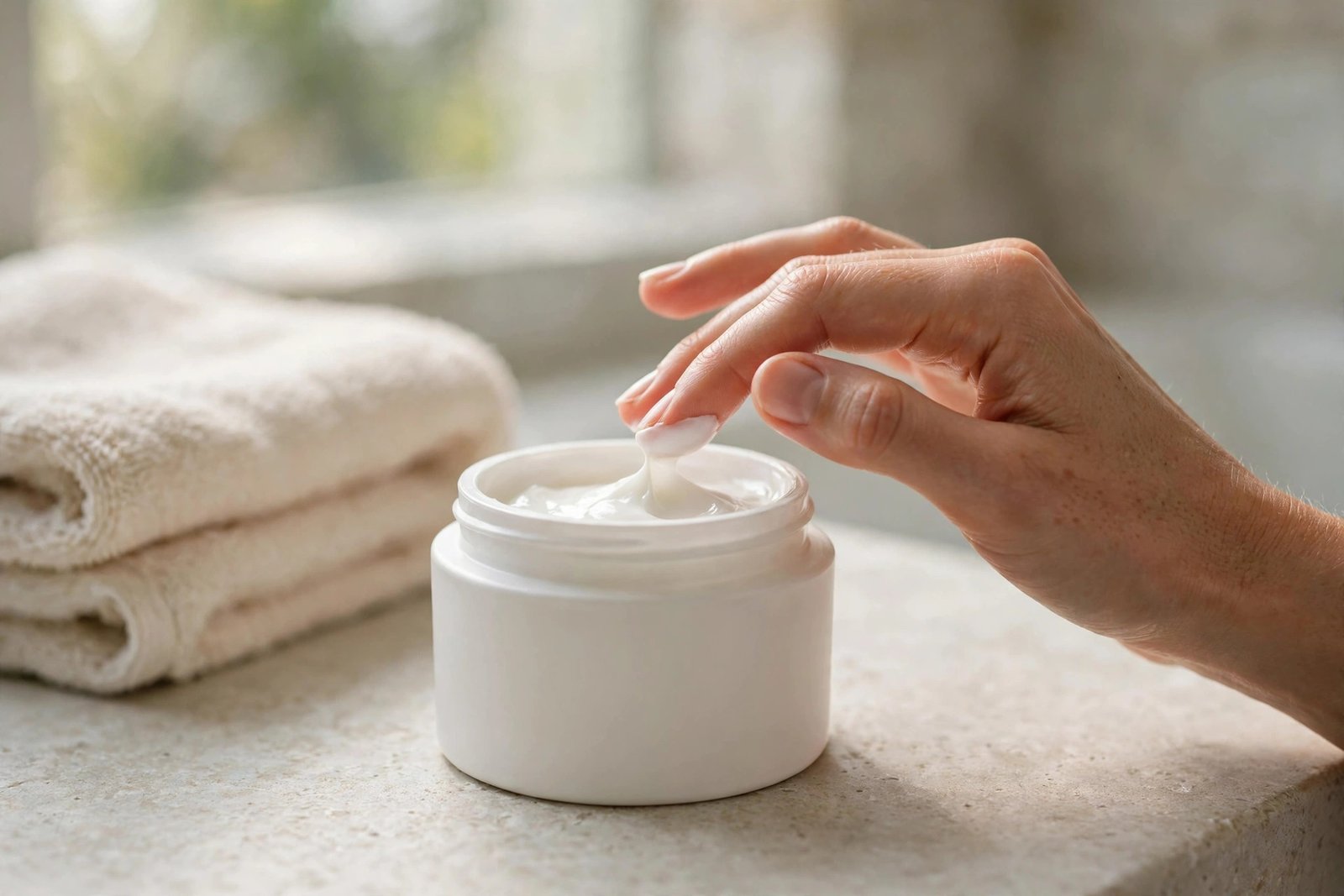
Moisturizer goes over everything so far, in a weight matched to your skin: a light lotion or gel-cream for oilier skin, a richer cream for drier skin. It holds in the water and lighter layers beneath it. Apply to face and neck, and let it settle briefly before the final step.
Step 6: Sunscreen
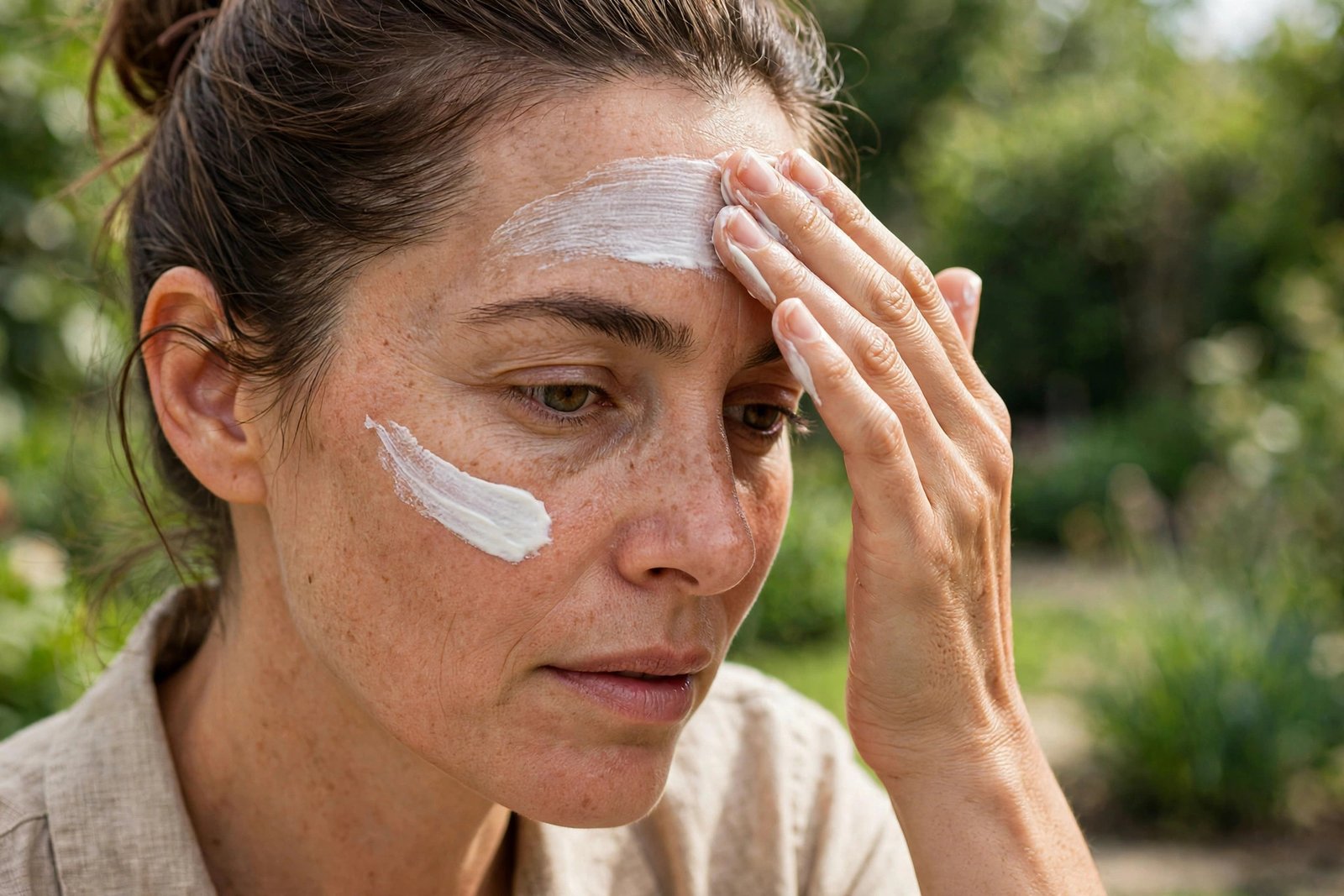
Sunscreen is the last skincare step of the morning, every morning. Choose a broad-spectrum product — SPF 30 or higher is the level the American Academy of Dermatology points to for daily wear — and apply it generously to face, neck, and any other exposed skin. Let it set a few minutes before makeup so the film stays even; makeup goes on after sunscreen, never underneath it, and our guide to a natural everyday makeup look starts exactly where this step ends. Reapply during the day if you are outdoors, sweating, or swimming, per your product’s directions.
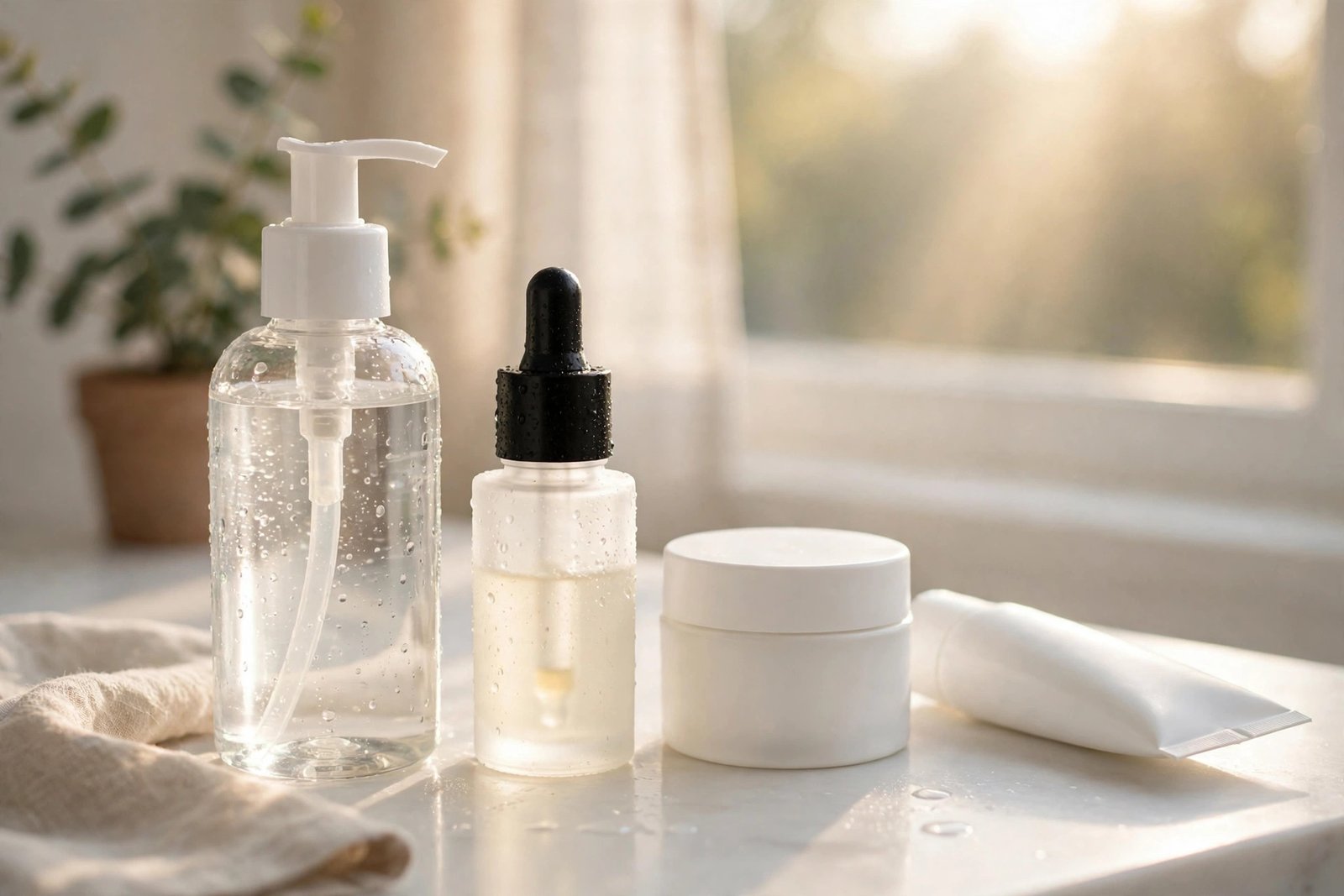
The Evening Routine, Step by Step
Step 1: Cleanser
Evening cleansing has more to remove: sunscreen, makeup, and the day itself. If you wore makeup or water-resistant sunscreen, remove it first with a makeup remover or cleansing balm, then wash with your regular cleanser. Cleveland Clinic’s guide advises cleansing once per session rather than repeated rounds, which do more harm than good. Skin should feel clean, not tight.
Step 2: Toner or Essence (Optional)
Same position as the morning, same status: optional. It can make later steps spread more comfortably on damp skin, but nothing that follows depends on it.
Step 3: Treatment or Serum
Evening is when stronger treatments belong, because ingredients used for texture and tone — retinoids are the best-known example — are typically used at night and can make skin more sun-sensitive. Apply your treatment to clean, dry skin and let it absorb. A hydrating serum, if you use one instead, takes this same slot. One treatment at a time is a sensible default.
Step 4: Eye Cream (Optional)
As in the morning: a small amount, tapped gently around the orbital bone, after your treatment step and before moisturizer.
Step 5: Moisturizer
Your evening moisturizer can be your morning product or a richer cream if your skin runs dry. It buffers the treatment underneath and supports the skin barrier overnight, when dryness from actives tends to show up.
Step 6: Face Oil (Optional)
If you use a face oil, it goes on last, over moisturizer — oils are the thickest, most sealing layer in a routine, so anything water-based applied after them has nowhere to go. It suits dry skin best; Cleveland Clinic’s guide is cautious about face oils for acne-prone skin.
Where Common Active Ingredients Fit
Actives need no special positions of their own. Each belongs to a slot you already know:
- Vitamin C sits in the morning serum slot, commonly paired with sunscreen — which it supports, never replaces.
- Hyaluronic acid and other hydrating serums fit the serum slot in either routine, before the moisturizer that seals hydration in.
- Niacinamide is usually sold as a serum, so it takes the serum slot in either routine.
- Retinoids (such as retinol) belong in the evening treatment slot, on dry skin, followed by moisturizer. A pea-sized amount for the whole face is enough; more does not work faster.
- Exfoliating acids (AHAs and BHAs) are treatments, not daily layers. Used a few evenings a week in the treatment slot, they are best kept away from the nights you use a retinoid, especially while you are still learning your skin’s tolerance.
The governing idea is rotation, not accumulation.
Common Layering Mistakes
- Applying moisturizer before serum. The most common ordering error: the cream partly blocks the lighter formula, which sits on the surface instead of reaching skin.
- Putting sunscreen under moisturizer or makeup. Sunscreen must be the final morning layer to form its protective film. Moisturizer first, sunscreen last, makeup after both.
- Mixing products in your palm to save time. Combining sunscreen with moisturizer or foundation dilutes it unevenly, so the protection on your face no longer matches the label. Apply separate layers.
- Stacking every active on the same night. A retinoid over an acid exfoliant over a second treatment is how a tolerable routine becomes a stinging one. Alternate nights.
- Adding several new products in the same week. When skin reacts, there is no way to know which one caused it. Introduce one at a time.
- Skipping moisturizer because skin is oily. Oily skin still loses water, and treatments dry skin further. Use a lightweight moisturizer; weight is a texture choice, not a reason to skip the step.
A Simple Beginner Routine
A complete routine fits on an index card — the minimum Cleveland Clinic’s guide describes:
Morning: cleanser, moisturizer, sunscreen. Evening: cleanser, moisturizer.
Live with it for several weeks before adding anything. If you later want a treatment, add a single product, in its correct slot, and give your skin time to respond before considering another. A short routine used consistently serves you better than a long one you abandon — and with four or five products total, a reaction has very few suspects.
Patch Testing and Introducing New Products
Before a new product goes on your whole face, test it: apply a small amount to a small, discreet area — inside the wrist or behind the ear are common choices — for a few days, watching for redness, itching, burning, or bumps. The American Academy of Dermatology offers the same advice: introduce one new product at a time, and test a small amount first, especially if your skin is sensitive.
Patch testing isn’t a guarantee; a product can pass and still irritate your face, and some reactions build over weeks. Treat it as a filter for obvious problems. If a product stings persistently or burns, stop using it.
The Limits of Any General Routine
This guide is cosmetic guidance about product order, not medical advice. It cannot diagnose or treat any skin condition, and no layering sequence will resolve acne, eczema, rosacea, persistent redness, or pigmentation disorders — those are reasons to see a dermatologist. Prescription products carry their own instructions, which override everything here, as do product labels: where a label and a general guide disagree, follow the label. This order is a well-supported default, not a promise that any product will work for any particular person.
Frequently Asked Questions
Does serum go before or after moisturizer?
Before. Serums are thin and water-based; moisturizers are thicker and partly occlusive, so the serum reaches clean skin first and the moisturizer seals it in. The same logic applies morning and evening.
How long should I wait between layers?
Long enough for each layer to stop feeling wet — usually well under a minute for toners and serums. Sunscreen deserves a few settled minutes before makeup so its film stays even.
Can I skip toner and eye cream?
Yes. Both are optional in an otherwise complete routine. The essentials are cleanser, any treatment you use, moisturizer, and sunscreen in the morning.
Should my morning and evening routines be different?
Only in two places: sunscreen belongs to the morning only, and sun-sensitive treatments such as retinoids belong to the evening. Every other step holds the same position in both.
Conclusion
Skincare routine order comes down to one habit: thin to thick, treatments close to clean skin, moisturizer to seal, and sunscreen alone at the end of the morning. Everything else — the optional toner, the eye cream placement, the rotation of actives — refines that single idea. Start with the short version, add one product at a time, and let your skin’s responses, not the size of your shelf, decide how long your routine deserves to be.


One comment on “Skincare Routine Order: How to Layer Your Products Correctly”